Key Results at a Glance
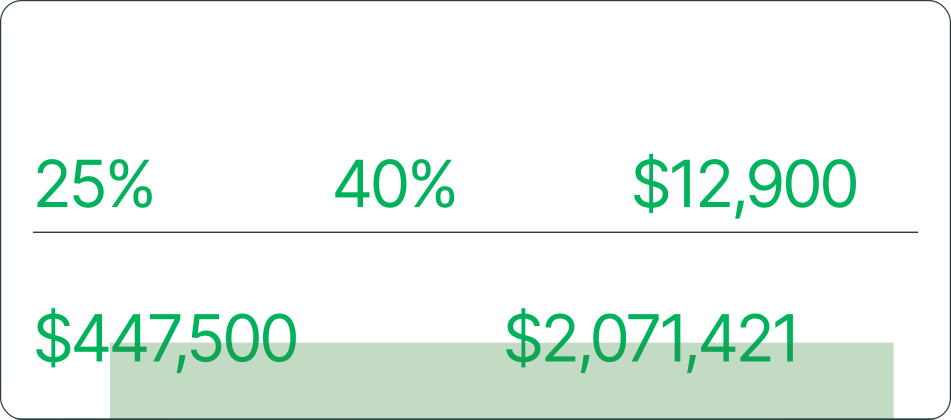
- Zero comment forms on Sanville & Company’s first PCAOB inspection conducted entirely on Fieldguide, the firm’s first fully clean broker-dealer inspection
- A full platform and methodology overhaul completed in under a year, against an expected 18 to 24 months
- Blended realization up from $150–$200 an hour to $250+ on the firm’s lowest-margin engagements, even reaching $300–$350 an hour in some cases
About Sanville & Company
Sanville & Company is a boutique audit and tax firm serving the financial services sector: broker-dealers, hedge funds, mutual funds, investment advisors, and private funds, including private equity vehicles and SPVs. The firm audits more than 150 broker-dealers and close to 100 mutual funds and ETFs, and its client base keeps growing. Sanville runs lean, about 20 people, which makes every hour matter.
Nathan Hartgraves, CPA, Partner at Sanville & Co, was one of the firm’s earliest advocates for Fieldguide, having followed the platform since its early SOC reporting days and asking to be first in line when financial audit support became available.
A Methodology That Was Fighting the Firm, Not Supporting It
Before Fieldguide, Sanville was on a platform that tried to be both the technology and the methodology in one package, and, in Nathan’s telling, did neither well.
“The problem is they didn’t do either one of them very well,” he says. “If you’re trying to do too many things, you can screw up the entire picture very quickly.”
The firm submitted product feedback and heard nothing back. The vendor’s license model gave them no real path to influence the roadmap. The limitations showed up in Sanville’s niche industry offerings. Broker-dealer and fund audits require audit testing volume that punishes any manual process: sample selections running into the hundreds of transactions, each one requiring evidence to be traced and vouched by hand. Reviewers would often absorb the backlog.
“It’s common to see bottlenecks with accounting firms where you’re trying to get engagements done,” Nathan says. “There’s always a logjam, either with the partner itself or the engagement quality review (EQR).”
Layered on top was a compliance deadline: QC 1000, the new PCAOB quality management standard for registered firms, was on its way. Sanville needed a technology partner willing to build a methodology tailored to its niche financial services focus, not a generic template, and it needed to move fast.
Building a Methodology That Actually Fits the Work
Fieldguide’s methodology-agnostic approach let Nathan build Sanville’s audit programs from scratch, referencing PCAOB standards directly in each step and deploying them across every engagement at once.
“The ability to create a template and then send it out to all of our engagements, and also adjust the template for any future engagements, enabled us to implement the audit programs across the firm, adopt things quickly, and also improve overall quality,” he says.
Inside Sheets, Field Auditor’s agentic testing took over the sample-heavy work that used to be time-consuming during fieldwork. Incoming PBCs were automatically traced to the selections requested, cutting out the time required to validate and screen received support documentation, which previously stalled revenue and related-party testing.
“There were sample selections of, say, hundreds of transactions that used to take hours to do, and literally, in many cases, it was down to minutes,” Nathan says.
Standardization tightened the whole operation. Workflows built once could be saved and reused firm-wide, and audit programs became a single firm-accepted template, with partners able to make updates based on their preferred procedures and client engagement. When a PCAOB exam flagged an issue the year before, Nathan updated the program and pushed it to every open engagement the next morning.
Additionally, Insights, an engagement analytics tool within Fieldguide, gave him visibility into budget-to-actuals and per-engagement profitability for the first time, turning fee conversations with clients into a data discussion instead of an argument.
A Clean Inspection and a Faster Path to Get There
The clearest proof point came from the PCAOB itself. Sanville’s first inspection on the Fieldguide platform, a broker-dealer engagement, came back with zero comment forms, the first fully clean inspection in the firm’s history.
“I fell out of my chair,” Nathan says. “They mentioned that Sanville was at the forefront of using AI, notably, for the size of our firm relative to the volume we produce, we’re in a league of our own.”
The transition itself moved faster than planned. Nathan expected the platform and methodology overhaul to take a year and a half to two years. Instead, it was completed in under a year.
Margins moved too: on what had historically been the firm’s lowest-priced, lowest-margin engagements, blended realization climbed from roughly $150–$200 an hour to $250 or more, and as high as $300–$350 an hour in some cases.
Capacity gains showed up where it mattered most: busy season.
“We supported more clients in the same amount of time, and it didn’t feel any different from any other busy season,” Nathan says.
The freed-up time shifted day-to-day responsibilities as well. First-year staff who previously had no shot at complex revenue testing are now doing it because reviewers finally have the bandwidth to guide them through it, building up their technical knowledge sooner.
Bringing the Rest of the Firm Along
The platform’s reach at Sanville has grown past audit engagements. A client who used Fieldguide’s portal to submit support documents liked the experience so much that they asked Sanville to put its tax team on the same system.
New feature requests submitted through Fieldguide’s support chat have shown up in production within weeks, something Nathan says never happened with the firm’s previous vendor. It felt like a true partnership.
His advice to firms is to lean into the platform immediately rather than easing in and to identify the practitioners on staff who want to push the work forward but have been held back by the old process. Those are the people who will carry adoption and continue to grow at the firm.
Nathan sums up the broader alignment simply: “You guys [Fieldguide] are a market disruptor. That’s what we’re trying to be as well, for what we do.”